PROGRAMME LINEUP
Workshop #1: Digital Robotic Prefabrication: From North America to Asia
Speakers:
- Dr. Ci-Jyun (Polar) Liang, Assistant Professor, Department of Civil Engineering, Stony Brook University;
- Dr. Shang-Hsien (Patrick) Hsieh, Professor, Department of Civil Engineering, National Taiwan University;
- Dr. Cheng-Hsuan (Jason) Yang, VP Robotics, RoBIM Technologies;
- Mr. Liang-Ting (Tim) Tsai, VP Software, RoBIM Technologies
Date & Time: 22nd June 2026 (Monday) 10am – 12nn
Venue: EA-06-02
Requirements: Up to a maximum of 50 participants
Synopsis:
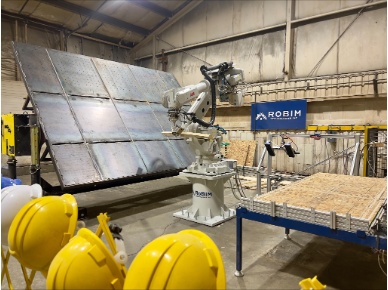
The objective of this workshop is to explore how multifunctional robotic fabrication systems can be adapted to distinct material and building cultures in different regions. In North America, dimensional lumber is the predominant building material, especially for the prefabrication construction industry. The multifunctional robotic systems (one robot with multiple end-effectors) are being developed with this focus. However, the building materials and prefabrication construction methods in Asia are very different from those in North America, which raises the adoption challenge for research and development of digital robotic prefabrication systems across the two regions. This workshop will first introduce one of the multifunctional robotic systems, RoBIM simulator (https://www.robimtech.com/hive), and provide hands-on sessions to explore the capabilities. Then, the participants will form small groups to discuss several prefabrication scenarios in Asia and identify opportunities for robotic adoption. The expected outcomes include a roadmap for research on multifunctional robotic systems and conceptual robotic workflows tailored to regional needs.
Workshop #2: Construction Site of the Future: Human Robot Collaboration Simulation Game
Speakers:
- Yifan Xu, The University of Manchester, UK
- Kota Fujimoto, Kyoto Institute of Technology, Japan
- Clara Cheung, The University of Manchester, UK
- Akilu Yunusa Kaltungo, The University of Manchester, UK
- Tsukasa Ishizawa, The University of Tokyo, Japan
- Ming Shan (Charmaine) Ng, Kyoto Institute of Technology, Japan
Date & Time: 22nd June 2026 (Monday) 10am - 12nn
Venue: EA-06-06
Requirements: Up to a maximum of 30 participants
Synopsis:
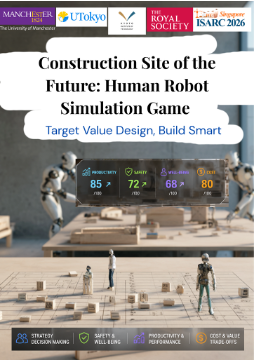
This interactive workshop presents a simulation game designed based on target value design principles, inviting participants to take on the roles of various construction project professionals and explore how humans and robots can effectively work together on site. Through a hands on simulation game, teams will make decisions about deploying workers and robotic systems while navigating key constraints such as cost, safety, productivity and workers’ well-being. Participants will work in small groups and take part in two structured rounds. The first round focuses on cost driven decision making, while the second introduces a broader perspective, encouraging teams to balance multiple performance criteria and think in terms of overall project value. Throughout the session, each team will select different collaboration strategies and experiment with varying types and numbers of robots, observing how these choices influence project outcomes. It is designed to be both accessible and reflective. It provides a practical way to explore trade offs in human robot collaboration, while also encouraging discussion on what information and tools are needed to support better decision making in practice. Participants will have the opportunities to reflect on their choices and compare approaches across teams, stimulating insights regarding how industry professionals engage with emerging construction technologies.
Workshop #3: Modelling for Construction Capacity and Capability: Portfolio Planning, Lean Philosophy, and Lessons from CanConstructNZ
Speakers:
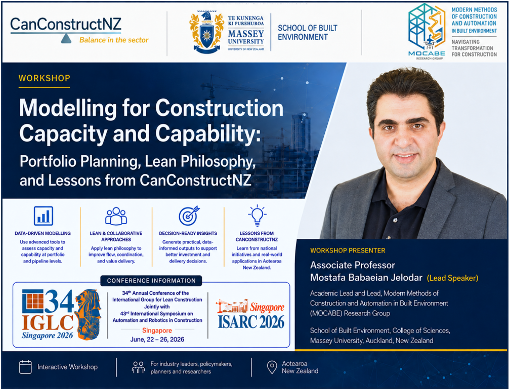
Associate Professor Mostafa Babaeian Jelodar (Lead Speaker)
Date & Time: 22nd June 2026 (Monday) 10am – 12nn
Venue: EA-06-07
Requirements: Bring a smartphone or laptop. Paper based questionnaires/surveys may be circulated during the workshop.
Synopsis:
This workshop presents CanConstructNZ; a Ministry of Business, Innovation and Employment (MBIE) Endeavour Fund programme (~NZD 10 million incl. GST); as a unique national initiative developing a "comparator mechanism" to understand construction demand (projects within the construction pipeline) alongside the supply-side sector’s capacity and capability to deliver. Framed through lean philosophy at the portfolio level, the workshop demonstrates how modelling and decision-support tools can strengthen flow, reliability, and coordinated planning across programmes and project pipelines. Participants will be introduced to the CanConstructNZ-developed platform and associated tools, including relational modelling, agent-based modelling (ABM), dashboards (e.g., Power BI), optimisation approaches (including genetic algorithms), and a composite index that synthesises multiple indicators into decision-ready signals. Through short demonstrations and an interactive co-design exercise, participants will identify key portfolio constraints and map them to appropriate modelling approaches, while defining practical dashboard outputs tailored to different users (clients, contractors, regulators, and supply chains). The workshop will generate transferable use cases, a lean-informed modelling template, and a practical roadmap for capacity and capability enhancement that can be adapted across regions and countries. Further information: https://canconstructnz.org.nz/
Workshop #4: Process Analysis for Construction: Practical Simulation Methods and Emerging Applications
Speakers:
- Dr. Joseph Louis, Oregon State University, USA
- Tim Berhard, Doctoral Researcher, Technical University of Munich, Germany
Date & Time: 22nd June 2026 (Monday) 10am - 12pm
Venue: EA-06-05
Requirements: No laptop required, but participants with Windows laptop may be able to run demonstration model.
Synopsis:
This workshop introduces practical process analysis methods, especially discrete event simulation, to help construction organizations move beyond improving isolated tasks and address broader system-level challenges such as logistics constraints, sustainability targets, circular construction, and multi-project coordination. Participants will learn how simulation can reveal workflow inefficiencies, bottlenecks, variability, and operational trade-offs across connected construction systems. The session also shows how these methods support lean construction principles by improving flow, reducing waiting, minimizing unnecessary movement, and enabling more reliable planning through testing alternatives before implementation. In addition, the workshop explores circular construction strategies including material reuse, component recovery, reverse logistics, and matching reclaimed materials to future demand, while addressing real-world uncertainties like timing, transport, storage, and coordination. Through guided exercises and practical examples, participants will gain an accessible introduction to simulation for lean improvement, circular economy initiatives, GIS-enabled planning, and regional resilience.
Workshop #5: To Inspire: A Game Playtesting Workshop for a Prototype that Stimulate Tangential Learning of Knowledge-Intensive Areas of Expertise
Speakers:
- Jack Tam, Kyoto Institute of Technology, Japan
- Yifan Xu, The University of Manchester, UK
- Clara Cheung, The University of Manchester, UK
- Tsukasa Ishizawa, The University of Tokyo, Japan
- Akilu Yunusa Kaltungo, The University of Manchester, UK
- Ming Shan (Charmaine) Ng, Kyoto Institute of Technology, Japan
Date & Time: 22nd June 2026 (Monday) 1pm – 3pm
Venue: EA-06-03
Requirements: None
Synopsis:
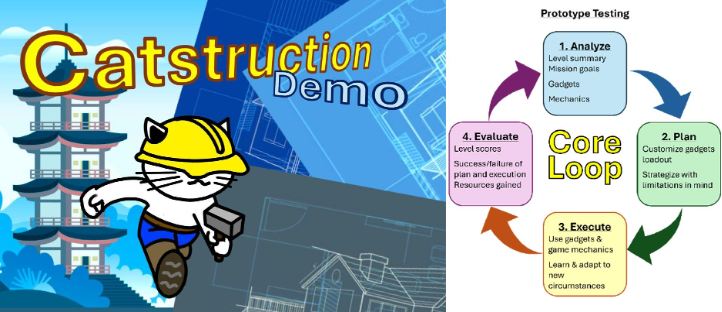
What if dismantling a building was a puzzle worth solving? Temple Rescue Cat is a hands-on game prototype where players must deconstruct a heritage structure carefully, salvaging members as treasures and navigating structural risks, without bringing the whole thing down. Collapse the temple, and the old cat trapped inside is lost.
Inspired by the logic of Japanese timber joinery puzzle games, the prototype challenges players to rethink deconstruction not as demolition, but as a skilled, methodical process of disassembly, material recovery, and decision-making under constraint. Scoring rewards players for cats saved, heritage preserved, smart technology use, animal and worker safety, and environmental impact.
Designed with K-12 accessibility in mind, the game requires no prior knowledge of construction. Players of all ages, backgrounds, and professions are welcome, and those working in built environment, heritage, robotics, or sustainability fields are especially encouraged to participate and share their perspective. Come play, then tell us what you really think about how we take buildings apart.
Workshop #6: From Line of Balance to Takt: A Hands-On Wind Turbine Assembly Simulation Using LEGO
Speakers:
- Bernardo Etges, Climb Group
- Racquel Reck, Climb Group
Date & Time: 22nd June 2026 (Monday) 1pm – 3pm
Venue: EA-06-04
Requirements: Maximum of 24 participants. No prior experience in Takt Planning or Lean Construction is required. Basic familiarity with production concepts is recommended. Participants are expected to bring a mobile device with a stopwatch function to support data collection during the simulation.
Synopsis:
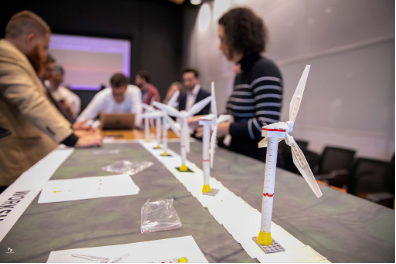
This hands-on workshop uses a LEGO-based wind turbine assembly simulation to help participants explore the transition from Line of Balance to Takt Planning in a structured and practical way. Through a two-round production exercise, participants first run a baseline system and collect structured production data to build a Line of Balance and assess system performance. In the second round, a new deadline is introduced, requiring participants to calculate takt time and redesign the production system accordingly. This redesign includes not only sequencing and crew allocation, but also logistics decisions such as material delivery setup, kit-based supply, and workstation layout changes. The workshop concludes with a comparison of the two production configurations, enabling participants to understand how planning and logistics decisions affect flow stability and overall performance while supporting data-driven decision-making through a simplified digital representation of the system.
Workshop #7: Intelligent Construction Systems: From Digital Innovation to Real-World Practice
Speakers:
- Dr Bing Lu, Lead Scientist, Advanced Materials Technology Centre, Singapore Polytechnic
- Assistant Professor Fu Yuguang, Nanyang Technological University
- Assistant Professor Nguyen Thi Qui, Singapore Institute of Technology
- Assistant Professor Cao Wenjun, University of Hong Kong
- Dr Liu Qinjun (Lavender), Lecturer in Construction Management, Productivity and Lean Construction, Western Sydney University
Date & Time: 22nd June 2026 (Monday) 1pm – 3pm
Venue: EA-06-05
Requirements: None
Synopsis:
This workshop examines the practical deployment of digital technologies in construction, including sensing, AI-based modelling, robotics, and data platforms, with attention to both local realities and international perspectives. Although many of these technologies have shown promise in controlled settings, their use in real projects remains limited. Grounded in actual project conditions, the session considers challenges such as regulatory requirements, climate, and site constraints in dense, tropical urban environments such as Singapore, while drawing lessons from global experiences. The workshop will begin with opening presentations by invited speakers both local and international, who will share case-based insights on implementation, integration, and performance validation. A moderated panel and structured discussion segments will then invite participants to contribute their own examples and challenges. Overall, the session aims to identify practical barriers, compare approaches, and explore directions for wider deployment and future collaboration.